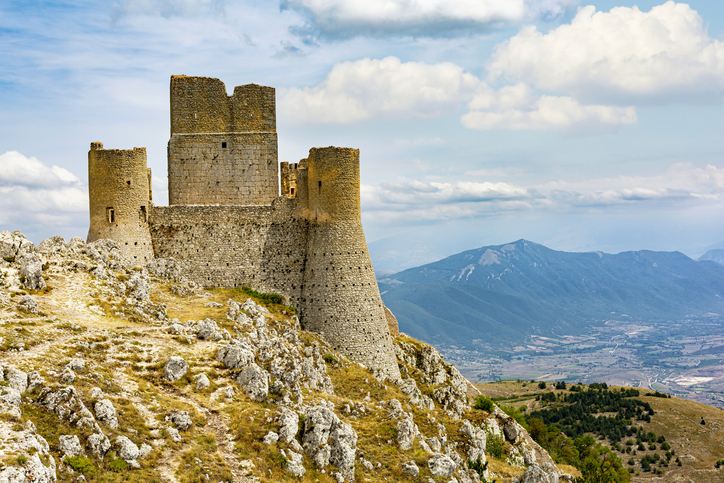
The Castle of Rocca Calascio. Image by Olga Mazyarkina via iStock
The Castle of Rocca Calascio, standing proudly in Italy’s Abruzzo region, embodies historical and architectural wonder. Its origin dates back to the late 10th century, initially serving as a watchtower. This castle isn’t just a structure; it’s a narrative in stone, chronicling the transitions from a military bastion to a residential quarter and ultimately to the captivating ruins that mesmerize visitors today.
Unlike the grandeur of many European castles, Rocca Calascio was primarily a military fortress. Its design is a rare specimen of medieval military architecture. It uses local stone and features a rugged, minimalistic style that underscores its original purpose. The layout, with a central tower or keep surrounded by defensive walls and cylindrical corner towers, is a strategic marvel of the medieval era.
Perhaps one of the most striking aspects of Rocca Calascio is its location. Perched at an altitude of 1,460 meters, it is among the highest fortresses in Italy. This elevated position offers not just strategic advantages but also stunning panoramic views. Overlooking the Gran Sasso d’Italia mountain range, the castle provides a vantage point that is both historically significant and visually breathtaking.
Rocca Calascio also enjoys a special place in cultural and cinematic history. Its scenic beauty has been a film backdrop, notably the 1985 movie “Ladyhawke.” This cinematic connection adds another layer to its appeal, drawing history enthusiasts and those fascinated by the arts and popular culture.
Despite the damage from an earthquake in the 1700s, Rocca Calascio has been preserved to a remarkable extent. This preservation, coupled with its accessibility to the public, allows for an immersive historical experience. The lack of modern developments in its vicinity adds to the authenticity of the experience, transporting visitors back in time.
The region surrounding the Castle of Rocca Calascio is rich in tourist attractions, offering a variety of experiences that cater to diverse interests, from natural wonders to historical sites.
One significant nearby attraction is the town of Santo Stefano di Sessanio. This medieval village, near Rocca Calascio, is known for its well-preserved architecture and historical ambience. The narrow cobblestone streets, ancient stone houses, and the quaint atmosphere of the village make it a delightful destination for those interested in experiencing Italian medieval life. Santo Stefano di Sessanio is also renowned for its artisanal crafts and local cuisine, providing an authentic taste of Abruzzo’s cultural heritage.
The Gran Sasso e Monti della Laga National Park is a must-visit for nature enthusiasts. It is one of Italy’s largest national parks, encompassing the majestic Gran Sasso mountain range. The park offers many activities, including hiking, mountain biking, and, in the winter, skiing. The diversity of landscapes within the park, from mountain peaks to lush forests, makes it a haven for wildlife and a beautiful destination for nature photography.
Another notable attraction is the Church of Santa Maria della Pietà, a small chapel near Rocca Calascio. This 17th-century church stands elevated, offering panoramic views of the surrounding landscape. Its unique octagonal structure and the legends associated with its origin add to its allure, making it a popular stop for visitors exploring the area.
L’Aquila is relatively nearby for those interested in exploring more of the region’s history. Although significantly affected by an earthquake in 2009, L’Aquila has been undergoing restoration and still offers a glimpse into the region’s rich historical and architectural past. The Basilica of San Bernardino, the Forte Spagnolo (a 16th-century fortress), and the Fountain of 99 Spouts are notable landmarks in L’Aquila.
Let’s create a 7-day itinerary around Rocca Calascio, including estimated costs, balancing historical visits, nature exploration, and cultural experiences. The prices can vary based on the choice of accommodation, dining preferences, and transportation methods.
Day 1: Arrival in L’Aquila – Start your journey in L’Aquila, the largest city near Rocca Calascio. Spend the day exploring the city’s historical centre and visiting landmarks like the Basilica of San Bernardino and the Forte Spagnolo. For accommodation, consider a mid-range hotel, with costs around €80-€120 per night. Dining in L’Aquila ranges from affordable trattorias to upscale restaurants, averaging €15-€30 per meal.
Day 2: L’Aquila to Santo Stefano di Sessanio – Travel to Santo Stefano di Sessanio, a beautiful medieval village. Spend the day wandering its cobblestone streets and enjoying local artisan shops. Accommodation in Santo Stefano di Sessanio is charming, with options like small bed and breakfasts, averaging €70-€100 per night.
Day 3: Exploring Rocca Calascio – Dedicate this day to visiting the Castle of Rocca Calascio. The area is perfect for hiking and photography. Plan for a modest entry fee if applicable, and budget for a picnic or a meal in a nearby restaurant. In the evening, return to your accommodation in Santo Stefano di Sessanio.
Day 4: Gran Sasso e Monti della Laga National Park – Explore the national park, engaging in activities like hiking or guided tours. Depending on the activities, set aside €20-€50. Return to Santo Stefano di Sessanio for the night.
Day 5: Church of Santa Maria della Pietà and Campo Imperatore – Visit the Church of Santa Maria della Pietà in the morning, then spend the afternoon at Campo Imperatore, a high mountain plateau known as “Little Tibet.
Day 6: Back to L’Aquila – Return to L’Aquila, exploring any missed sights. Consider a more relaxed day, enjoying the city’s cafes and local shops.
Day 7: Departure – Use this day to depart or visit a local museum or gallery if time allows.
It’s advisable to book accommodation in advance and consider travel insurance. This itinerary offers a balance of historical exploration, nature activities, and relaxation, providing a comprehensive experience of the region’s rich offerings.